WARNUNG: Dieses Produkt enthält Nikotin. Nikotin ist eine süchtig machende chemische Substanz.
WARNUNG: Dieses Produkt enthält Nikotin. Nikotin ist eine süchtig machende chemische Substanz.
WARNUNG: Dieses Produkt enthält Nikotin. Nikotin ist eine süchtig machende chemische Substanz.
WARNUNG: Dieses Produkt enthält Nikotin. Nikotin ist eine süchtig machende chemische Substanz.
A disposable vape often looks very simple from the outside: a small housing, a mouthpiece, perhaps a display, and perhaps a USB-C port. In everyday life, it may seem like a ready-to-use lifestyle product that you simply unpack and use. Inside, however, there is a small system made up of a battery, e-liquid, coil, wick, airflow sensor, electronics, housing, and sometimes a display or LED.
Understanding what is inside a disposable vape makes it easier to compare products. Suddenly, puff count is not the only interesting factor. You can also understand why one device delivers more flavor, why another becomes weak more quickly, why some models flash, why a display can be useful, and why disposable vapes should not be placed in normal household waste.
This article explains the internal components from a consumer perspective. It is not a guide to opening or repairing a vape. Disposable devices should not be broken open, modified, or refilled unless they are explicitly designed for it. Many vapes contain nicotine, which can be addictive. Nicotine-containing products are intended for adults only.
The battery, coil, e-liquid tank, and airflow sensor work together with every puff.
The Short Answer: What Is Inside a Disposable Vape?
A typical disposable vape consists of several small components that work together to produce each puff:
Housing: Protects the components and determines the shape, feel, and design.
Mouthpiece: Directs vapor to the user and affects the draw experience.
E-liquid or e-liquid reservoir: Contains flavoring, base liquid, and, depending on the product, nicotine.
Wick or cotton: Carries e-liquid to the heating surface.
Coil or mesh coil: Heats the e-liquid and produces aerosol.
Battery: Supplies power to the electronics and coil.
Airflow sensor: Detects the puff and activates the device.
Electronics: Control power, protection functions, LED, or display.
Modern high-puff devices often add a display, multiple flavor modes, a charging port, or dual tanks. These extras are exactly what distinguish a very simple disposable device from a more noticeable lifestyle model.
1. The Housing: More Than Just Packaging
The housing determines how a disposable vape feels in the hand. Round, flat, transparent, angular, matte, glossy, small, or large: the shape is not only about appearance. It affects whether the device fits in a pocket, whether the mouthpiece feels comfortable, whether the display is easy to see, and how sturdy the vape feels.
From a lifestyle perspective, the housing is often the first purchase trigger. Color, texture, and design can communicate a sporty, minimalist, futuristic, or playful look. Technically, however, the housing also needs to securely contain the e-liquid, battery, electronics, and airflow channels. Attractive design is of little value if the device leaks easily or draws poorly.
When comparing devices, consider:
Does the device feel comfortable in the hand?
Is the mouthpiece well finished and cleanly made?
Is the display easy to read?
Does the housing feel sturdy and well sealed?
2. Battery: The Invisible Foundation of Usable Life
The battery is the vape’s power source. Without it, the coil cannot heat, the display remains dark, and the airflow sensor cannot trigger a signal. In simple disposable devices, the battery is non-rechargeable. Rechargeable disposables also include a charging port, usually USB-C or sometimes Micro-USB.
Battery capacity affects how long a device can be used, but it is not the only factor. Puff count, e-liquid volume, coil power, display, puff duration, and charging behavior also play a role. A larger battery does not automatically mean better quality if the e-liquid or coil is not appropriately matched.
A display showing battery level can be practical. It makes it easier to tell whether a weak puff is caused by a low battery or nearly depleted e-liquid. This is why modern devices with battery indicators can feel more transparent in everyday use.
3. E-Liquid Reservoir: Where the Flavor Is Stored
Inside the device is an e-liquid reservoir or material saturated with e-liquid. This liquid carries the flavor. It typically consists of a base liquid, flavoring, and, depending on the product, nicotine. The exact composition varies by brand, market, and product version.
For users, the e-liquid is experienced mainly through flavor, sweetness, cooling effect, and aftertaste. When flavor becomes weaker, it is often because less e-liquid is reaching the coil or the reservoir is nearly empty. If the device tastes burnt, the wick may be dry.
Lifestyle products often use clearly defined flavor profiles:
Fruit and ice for a fresh impression.
Candy profiles for sweeter, more noticeable flavors.
Menthol or mint for a simple cooling profile.
Tobacco or dessert profiles for more subdued flavor options.
4. Coil and Wick: Where Flavor Becomes Vapor
The coil is the heating element. The wick, often made from cotton or fiber material, carries e-liquid to the coil. When you puff, the coil heats up and converts the e-liquid into aerosol. Whether the draw feels smooth, warm, intense, or weak depends heavily on the coil, wick, e-liquid, and power level.
Many modern devices use mesh coils because they can provide a larger heating surface. This can make flavor feel more consistent. When the coil and e-liquid are well matched, flavor may remain stable for longer. If the e-liquid is too thick, the coil runs too hot, or the wick cannot keep up, the draw may taste dry or burnt.
For buyers, this means that a high puff count may sound appealing, but the coil also helps determine whether that usable life remains enjoyable. A device that tastes strong at first but declines quickly later may not be well balanced internally.
5. Airflow Sensor: Why the Vape Activates When You Puff
Most disposable vapes do not have a traditional fire button. Instead, an airflow sensor detects when you puff on the mouthpiece. The sensor activates the electronics, the coil briefly receives power, and the device produces vapor. This makes operation very simple: puff, release, done.
The airflow sensor affects the draw more than many people realize. A sensitive sensor activates with a light puff, while a less sensitive sensor requires a stronger draw. If condensation, dust, or e-liquid residue interferes with the airflow path, the vape may become harder to draw or respond inconsistently.
That is why the mouthpiece should be kept clean and the device should not be puffed with excessive force. If a vape no longer responds properly, the battery is not always the only possible cause. The airflow path, sensor, or e-liquid level may also be involved.
6. LED and Display: Small Indicators With Big Everyday Benefits
Many older disposable vapes had only a small LED. It indicated that the device was active or that the battery might be low. Modern devices go further: they may show battery level, e-liquid level, mode, or puff information. This fits the lifestyle trend toward greater control and less guesswork.
A display is not essential, but it can be practical. It helps users assess the battery and e-liquid more easily. When the indicator is low, it becomes easier to determine whether charging makes sense or whether the device is nearly empty. On high-puff models, a display can therefore provide a genuine convenience benefit.
However, remember that an indicator is only as useful as its implementation. It does not replace clear product information, and it does not guarantee that every advertised puff will be achievable.
7. How the Internal Components Affect the Lifestyle Experience
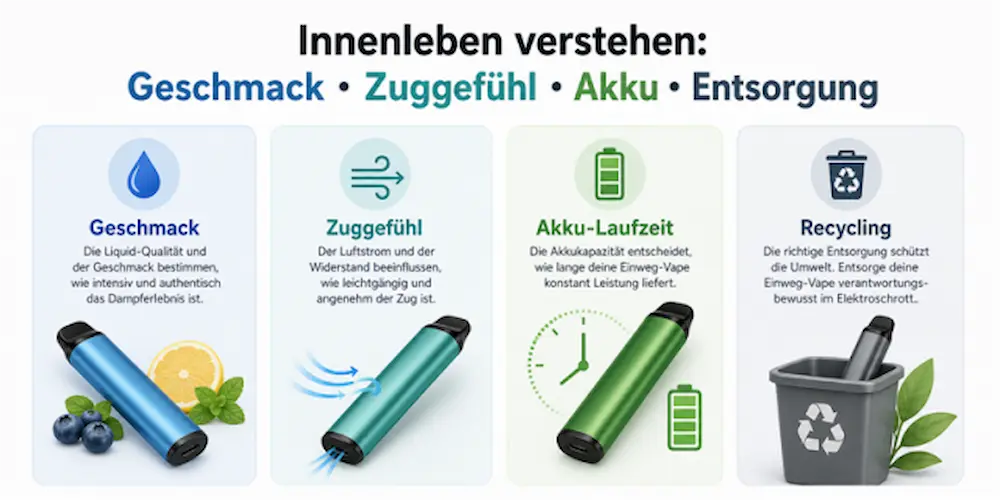
E-liquid, airflow, battery, and disposal all shape the overall user experience.
A disposable vape is not only a piece of technology. It is also an everyday object. Its internal design determines whether it feels convenient, modern, high-quality, or frustrating. A good battery supports predictable use. A well-matched e-liquid and coil system helps maintain consistent flavor. A good airflow sensor creates a natural draw. A useful display reduces uncertainty.
This is exactly why many buyers now compare not only price and flavor but also displays, charging ports, mesh coils, puff counts, design, and how the device feels in the hand. Lifestyle appeal is not created only by color and packaging. It also comes from whether the device works reliably in everyday use.
A strong lifestyle-oriented device should:
Clearly indicate what is happening with the battery or e-liquid.
Deliver consistent flavor, not only on the first day.
Provide a comfortable draw without becoming blocked.
Be sturdily built and resistant to leaking.
Be capable of responsible disposal.
8. Why Disposable Vapes Should Not Go Into Household Waste
The internal components also explain why disposable vapes should not simply be placed in normal household waste. They contain electronics, often a lithium-ion battery, and residual e-liquid. This means they should be collected and disposed of properly. Incorrect disposal can create environmental and safety problems.
Because disposable vapes are small, they are easy to underestimate. They may look harmless from the outside, but there is a battery inside. Consumers should therefore use appropriate return or collection points and follow local disposal guidance. A device that has leaked, been damaged, or become hot should be handled with particular care.
The lifestyle perspective should therefore not stop at design and flavor. A modern device should also be used responsibly and disposed of correctly at the end of its life.
9. What Buyers Should Check Before Purchasing
Understanding what is inside makes product pages easier to evaluate. Instead of looking only for the highest puff count, it is worth checking the details. Is there a battery indicator? Is the device rechargeable? Is a mesh coil specified? Are nicotine strength and product details clearly stated? Is there information about disposal, authentic products, and age verification?
A practical checklist:
Battery: Rechargeable or not?
E-liquid: Clear information about flavor and nicotine strength?
Coil: Mesh, dual mesh, or not specified?
Indicator: LED, display, battery level, or e-liquid level?
Housing: Comfortable, well sealed, and well made?
Disposal: Is return or disposal guidance provided?
On vapevip.de, you can compare these product details directly. Especially with high-puff models, it is worth looking beyond the number and considering how the battery, e-liquid, coil, and display work together.
10. What You Should Not Do With a Disposable Vape
Because so much technology is packed into a small housing, disposable vapes should not be opened, dismantled, refilled, or repaired. Doing so can cause e-liquid leakage, battery damage, or electronic failure. Charging a device without an official charging port is also not a good idea.
Therefore, avoid:
Breaking open or dismantling the device.
Refilling e-liquid if the device was not designed for it.
Modifying or exposing the battery.
Charging non-rechargeable vapes.
Continuing to use damaged or leaking devices.
If a device tastes burnt, becomes hot, leaks, or no longer functions properly, it should no longer be used.
Final Answer: What Is Inside a Disposable Vape?
A disposable vape contains a housing, mouthpiece, e-liquid reservoir, wick, coil, battery, airflow sensor, electronics, and, depending on the model, an LED or display. Together, these parts determine how the vape tastes, how easily it draws, how long it lasts, and how easily users can assess the battery or e-liquid level.
From a lifestyle perspective, the internal components explain why two devices with a similar appearance can feel very different. A good device is not only attractive. It combines a suitable coil, stable e-liquid delivery, a practical battery, a comfortable draw, and clear indicators. A high puff count alone is not enough.
For buyers, the most important takeaway is: Do not look only at flavor and design. Also check the battery, charging port, display, coil type, nicotine strength, product information, and disposal guidance. This makes the purchase decision more informed.
FAQ
What Is Inside a Disposable Vape?
It typically contains a housing, mouthpiece, e-liquid, wick, coil, battery, airflow sensor, electronics, and sometimes an LED or display.
Does Every Disposable Vape Have a Battery?
Yes. Disposable vapes require a battery so the coil can heat the e-liquid. Not every battery is rechargeable.
What Does the Coil Do in a Vape?
The coil heats the e-liquid. Together with the wick, airflow, and power level, it affects flavor, vapor output, and draw quality.
Can You Open a Disposable Vape?
Disposable vapes should not be opened, repaired, or refilled unless they are explicitly designed for it.
Why Do Some Disposable Vapes Have a Display?
A display can show battery level, e-liquid level, or operating mode. This makes it easier to assess the condition of the device during everyday use.
Why Must Disposable Vapes Be Disposed of Properly?
They contain electronics, a battery, and potentially residual e-liquid. They should therefore be taken to appropriate return or collection points rather than placed in normal household waste.