WARNUNG: Dieses Produkt enthält Nikotin. Nikotin ist eine süchtig machende chemische Substanz.
WARNUNG: Dieses Produkt enthält Nikotin. Nikotin ist eine süchtig machende chemische Substanz.
WARNUNG: Dieses Produkt enthält Nikotin. Nikotin ist eine süchtig machende chemische Substanz.
WARNUNG: Dieses Produkt enthält Nikotin. Nikotin ist eine süchtig machende chemische Substanz.
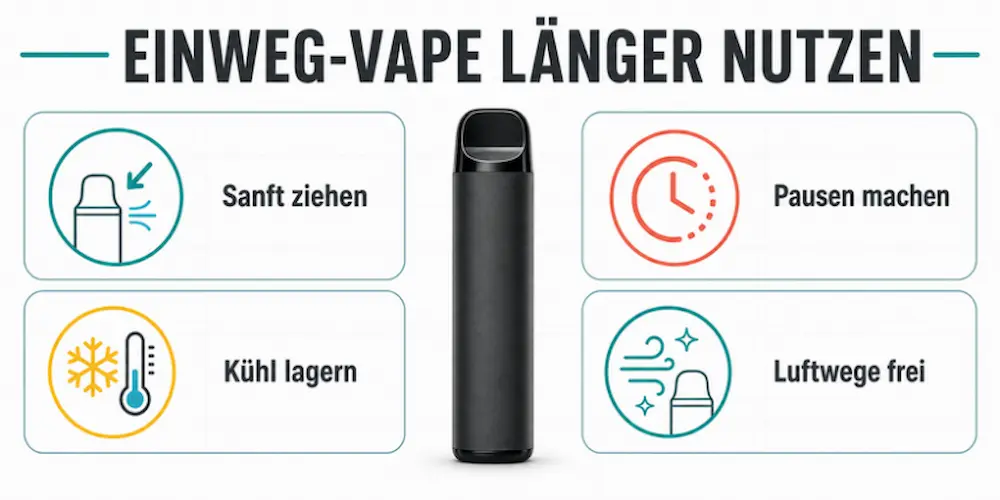
Short Answer: A disposable vape is more likely to reach its intended usable lifespan if you take smooth rather than very hard puffs, allow short recovery pauses, keep airflow openings clear, avoid excessive heat and cold, and only charge models explicitly designed to be rechargeable according to their instructions. These measures do not create extra e-liquid or guarantee additional puffs. Their main purpose is to avoid unnecessary consumption, dry-coil hits, and premature battery or device problems.
People searching for ‘how to make a disposable vape last longer’ usually mean the actual usable time after starting the device rather than its shelf life. An important limit applies here: you cannot increase a fixed e-liquid supply or restore a worn-out coil. You can, however, avoid long and forceful puffs, blocked airflow, extreme temperatures, and improper charging that may cause the device to become unusable sooner.
This guide is intended for adults only. Many disposable vapes contain nicotine, which can be addictive. The following tips are not an encouragement to use these products more frequently and do not make health or savings claims. The goal is proper handling of a product that has already been purchased, not pushing it beyond clear warning signs.
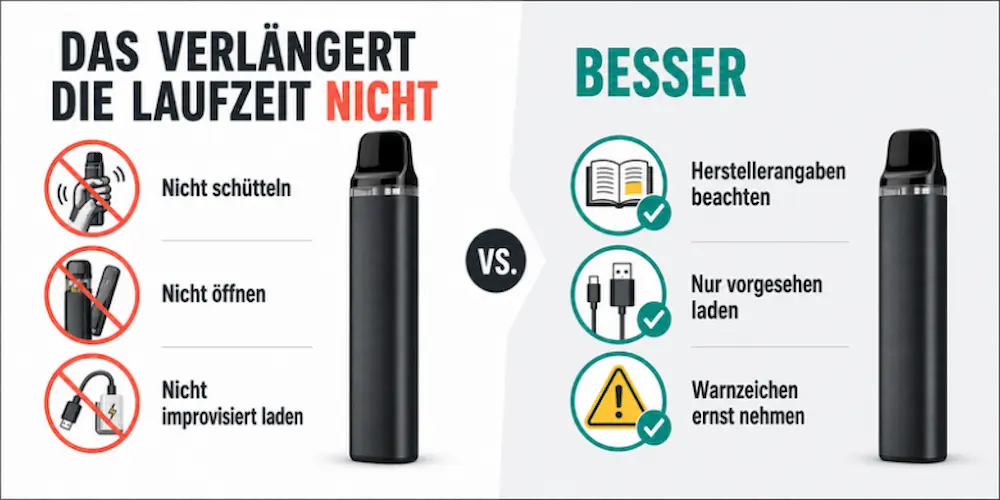
Shaking, opening, or improvised charging does not extend usable life. Follow manufacturer instructions and pay attention to warning signs.
What Actually Limits Real-World Usable Life
Three resources must work together: the battery supplies power, the e-liquid feeds the wick, and the coil vaporizes it. Normal operation ends when the first depleted or damaged component can no longer function. This is why focusing only on the advertised puff count is not very useful. A full battery cannot compensate for empty e-liquid, and another charging cycle cannot repair a burnt coil.
Factor
What Puts Stress on It
Gentler Handling
Clear Limit
E-Liquid
Long, forceful puffs; high power
Smooth, steady puffs; use an appropriate mode
Charging cannot replace depleted e-liquid
Coil and Wick
Many puffs without pauses; insufficient liquid flow
Allow recovery time between puffs
Stop if a burnt taste persists
Battery
Heat, cold, improper charging
Follow manufacturer instructions and use the intended charging port
Only charge rechargeable models
Airflow and Housing
Dust, pressure, blocked openings
Keep clean and dry and transport upright when possible
Do not continue using damaged or leaking devices
10 Tips to Help a Disposable Vape Avoid Ending Unnecessarily Early
1. Take Smooth, Steady Puffs Instead of Pulling Excessively Hard
A harder draw does not automatically mean a better or more efficient puff. It may move more e-liquid toward the coil, extend the heating period, and contribute to gurgling or spitback in some devices. Inhale as described in the instructions without forcing the airflow sensor to activate. If a normal puff does not work, first check protective parts and airflow openings instead of pulling increasingly harder.
2. Give the Coil Time Between Puffs
Several puffs taken back-to-back can heat the coil and wick faster than e-liquid can replenish them. A short pause helps the system stabilize thermally and allows the wick to become saturated again. There is no universal number of seconds because devices, power levels, e-liquids, and puff lengths vary. The practical sign is simple: if the vapor becomes unusually hot or the flavor becomes dry, do not keep accelerating your puff rate.
3. Do Not Block Airflow Openings With Fingers or Debris
Draw-activated vapes require unrestricted airflow. If an opening is covered while holding the device, the draw may become inconsistent and users often compensate by pulling harder. Before use, check externally that stickers have been removed and airflow openings are clear. Wipe the surface of the mouthpiece clean, but do not insert needles, wires, or tools deep into the housing.
A basic external inspection can also help confirm that the device is ready for normal use.
4. Use Boost or High-Power Mode Deliberately
Some models offer multiple power or airflow modes. Higher power can consume more e-liquid and battery energy per puff. For more consistent usable life, do not automatically select the strongest mode; read the manufacturer’s description and use an intended moderate setting. An Eco mode may reduce consumption, but it does not guarantee a specific number of additional puffs.
5. Avoid Heat, Direct Sunlight, and Extreme Cold
Lithium batteries and e-liquid do not perform well under extreme temperatures. A hot car, direct sunlight on a windowsill, or proximity to a heater can stress the battery, seals, and liquid flow. Extreme cold may temporarily reduce performance and make the e-liquid more viscous. Store the device in a dry place at normal room temperature; refrigerators and freezers are not sensible ways to extend its usable life.
6. Transport It Upright and Without Excessive Pressure
A vape carried loosely among keys, heavy objects, or in an overcrowded bag may be squeezed, contaminated, or accidentally activated. Keeping it upright and using a clean protective cap can better protect the airflow path and mouthpiece. This does not guarantee complete leak protection, but it reduces avoidable stress. If the housing becomes cracked, sticky, or leaky, stop using the device regardless of the remaining level.
7. Only Charge Models Designed to Be Rechargeable
A USB-C port on a disposable model explicitly designed to be rechargeable means the battery can be recharged within the manufacturer’s limits. Use the recommended cable and a suitable power source, charge on a non-combustible surface, and remain nearby. Do not charge devices that are warm, wet, swollen, or damaged. A model without an intended charging port should not be opened or charged using improvised wiring.
8. Read Battery and E-E-Liquid Indicators Together
On models with a display, separate indicators can help identify the limiting factor. If only the battery is low, proper charging of a rechargeable model may restore normal performance. If the e-liquid indicator is empty or the flavor remains dry despite a full battery, additional charging cycles will not help. Use the indicators for planning, but never as a reason to ignore warning signs.
9. Avoid Opening Too Many Devices at Once
Starting several flavors at the same time and leaving individual devices unused for weeks increases the number of partially used products. The mouthpiece, battery, and e-liquid do not remain unchanged indefinitely after use begins. It is more practical to use an opened device appropriately within a reasonable period rather than scattering multiple active devices across a car, jacket, and drawer.
Usable operating life and storage life are separate considerations, especially after a disposable vape has been opened and used.
10. Accept the End of Use Before the Coil Runs Dry
The final theoretical puffs are not automatically usable puffs. If the flavor becomes persistently burnt, metallic, or unusually harsh, or if the device overheats, leaks, or stops responding normally, stop using it. Pulling harder, shaking the device, or charging it again cannot restore missing e-liquid. Proper use ends when normal function and safety end.
A 60-Second Routine Before and After Use
A short routine is more useful than complicated tricks. It is not intended to technically modify the device, but to prevent common everyday problems early. Follow these steps:
Inspect first: Check the housing, mouthpiece, and charging port for cracks, liquid, dirt, or deformation.
Hold it correctly: Do not cover airflow openings or squeeze the device.
Use it steadily: Take smooth puffs and pause if the device becomes hot or the flavor turns dry.
Interpret indicators correctly: Do not confuse battery level with e-liquid level.
Protect it afterward: Store it dry, upright, and out of reach of children.
How to Identify the Biggest Factor Shortening Your Device’s Usable Life
Not every tip affects usable life equally. On one model, continuously using Boost mode may be the main factor; on another, it may be long puffs, poor storage, or repeated late charging. Instead of relying only on impressions, briefly document the normal use of a device you already own. Do not increase the frequency or length of your puffs for this purpose; simply observe what normally happens.
Record the product version: Note the model name, advertised puff count, and whether the device is rechargeable. Different versions from the same brand should not be treated as identical devices.
Record the mode: Note whether you use Eco, Normal, Boost, or a particular airflow setting. Frequent mode changes make usable-life comparisons unclear.
Track charging cycles: Only charge devices designed for it and note whether normal performance actually returns after charging. Repeated charging when the e-liquid indicator is empty does not extend usable life.
Consider the environment: A day in a hot car or extreme cold is not comparable to dry storage at normal room temperature.
Identify the endpoint: Did the battery run out first, was the e-liquid depleted, did the coil burn out, or did a fault occur? This helps identify the actual limiting factor.
Only compare devices of the same product version under similar conditions. If a model performs much more consistently in a moderate mode than in its strongest mode, power selection is likely relevant. If the same early failure repeatedly occurs despite careful use, it may point more toward a product or batch issue than your puffing behavior. In that case, the receipt, packaging, and a brief description of the problem are more useful than further DIY attempts.
This type of observation is not a scientific measurement and is not an encouragement to reach a specific puff count. It can, however, help prevent confusion between advertised puff figures, battery status, and the device’s actual end of use.
These Runtime Tricks Do Not Help — and Can Be Risky
Smooth puffs, pauses, clear airflow, and appropriate storage help avoid unnecessary stress on the e-liquid, coil, and battery.
Shaking: does not distribute a small remaining amount in a controlled way and may move liquid into the airflow path. It does not create a new supply.
Blocking the airflow opening: changes the intended draw resistance and often only causes the user to pull harder.
Putting it in the refrigerator: cold temperatures can affect battery performance and e-liquid flow, while moisture and condensation create additional problems.
Charging overnight or continuously: unnecessary charging time does not replace e-liquid or a worn coil. Follow the instructions and do not leave the device charging unattended.
Prying it open or refilling through the mouthpiece: doing so does not turn a sealed disposable device into a safe refill system.
Key Point: Longer usable life comes from reducing unnecessary stress. It does not come from operating an empty or damaged device beyond its intended limits.
vapevip.de Selection Guide: Transparency Matters More Than the Highest Puff Count
For adult buyers, clear product information is more useful than one large advertised number. Battery and e-liquid indicators, understandable charging instructions, defined operating modes, warnings, and clear user guidance make proper handling easier. Advertised puff counts remain estimates because standardized test puffs and real-world use are not identical.
On vapevip.de, you can compare current models by indicators and operating features. Do not choose based only on maximum puff counts; also consider whether specifications, usage instructions, and the exact product version are clearly presented.
When Extending Use No Longer Makes Sense
A device should not continue to be used once a safety warning or end-of-life signal appears. Stop if there is significant heating, smoke, deformation, leakage, cracking, an unusual odor, a persistent burnt taste, or a fault that remains after the intended troubleshooting step. An unusually early failure is also not a reason to modify the device: document the purchase date, model, display information, and symptoms, then contact the retailer or manufacturer.
If you first need to determine whether the device is nearing the end of its supply, consider multiple end-of-life indicators. This guide instead focuses on avoiding premature loss of usable life throughout normal operation.
After Use: Return It Instead of Putting It in Household Trash
Even an empty disposable vape remains an electronic device containing a battery and possible e-liquid residue. It should not be placed in household waste, recycling bins, or public trash cans. In Germany, used devices can be returned to appropriate retailers and municipal collection points. Since July 1, 2026, take-back requirements for e-cigarette retailers have been expanded. Store damaged or leaking devices separately and inform collection staff about their condition.
Use an appropriate retailer take-back program or municipal electronic-waste collection point for disposal.
Health and Safety Notice
E-cigarettes are not risk-free. Nicotine can be addictive, and nicotine-containing products are intended for adults only. This article makes no medical claims and does not recommend vaping as a treatment or guaranteed smoking-cessation method. Use only correctly labeled products according to the original instructions and keep them away from children. If health symptoms occur, professional medical advice is more important than trying to optimize device runtime.
FAQ
Can I Double the Puff Count by Taking Shorter Puffs?
No. Doubling the puff count cannot be reliably promised. Puff length affects consumption, but power, e-liquid volume, coil design, airflow, temperature, and testing method also determine the real-world number.
Does a Disposable Vape Always Last Longer in Eco Mode?
A moderate mode may use less power and e-liquid per puff. The size of the difference depends on the model. Use only intended operating modes and follow the instructions.
Does Charging Make a Disposable Vape Last Longer?
Only on a model explicitly designed to be rechargeable can charging restore battery energy. It does not replenish e-liquid or repair a worn-out coil.
Should a Disposable Vape Be Stored in the Refrigerator?
No. Extreme cold can affect battery performance and e-liquid flow, and condensation may form. Dry storage at normal room temperature is more appropriate.
Why Does the Vape Taste Burnt So Early?
Possible causes include taking many puffs in quick succession, using a high-power mode, poor e-liquid flow, a defect, or an already low liquid level. Stop using the device if a burnt taste persists.
Does Pulling Harder Help When Very Little Vapor Is Produced?
Usually not. Check the airflow externally, battery and e-liquid levels, and the instructions. Pulling harder may increase consumption, gurgling, or dry hits.
Is It Better to Alternate Between Several Opened Vapes?
Not necessarily for product quality. Multiple partially used devices are easier to store incorrectly or forget. Open only as many as you can use appropriately within a reasonable period.
What Should I Do If a New Device Seems to Run Out Much Too Quickly?
Do not open it or attempt improvised charging. Record the purchase date, model, display information, and symptoms, keep the packaging and receipt, and contact the retailer or manufacturer.